VIGMA news
VIGMA 2021 wraps up: The Dark Room is Game of the Year
The second Video Game Critics Festival closed on 6 August 2021 with eight conference talks and the best Iranian games of the year, chosen by the critics' jury.
On this page17 sections
- Arash Naderi, UI/UX designer at CD Projekt RED
- Ehsan Kangarani, head of games at Cafe Bazaar
- Mohammad Amini, senior game designer at Fingersoft
- Behnam Keshani, head of digital marketing at NikPardakht
- Yasaman Farazan, programmer and game designer at Massive Miniteam
- Elham Ahmadi, head of the campaign team at Tapsell
- Mohammad Iraji, senior programmer at Ubisoft
- Mohammad Zehtabi, head of Paeezan studio
- VIGMA 2021 nominees and winners
- Most Creative Game of the Year
- Best Game Design
- Best Story and Narrative
- Best Art Direction
- Best Ongoing Game
- Best Music and Sound
- Most Anticipated Game of the Year
- Game of the Year
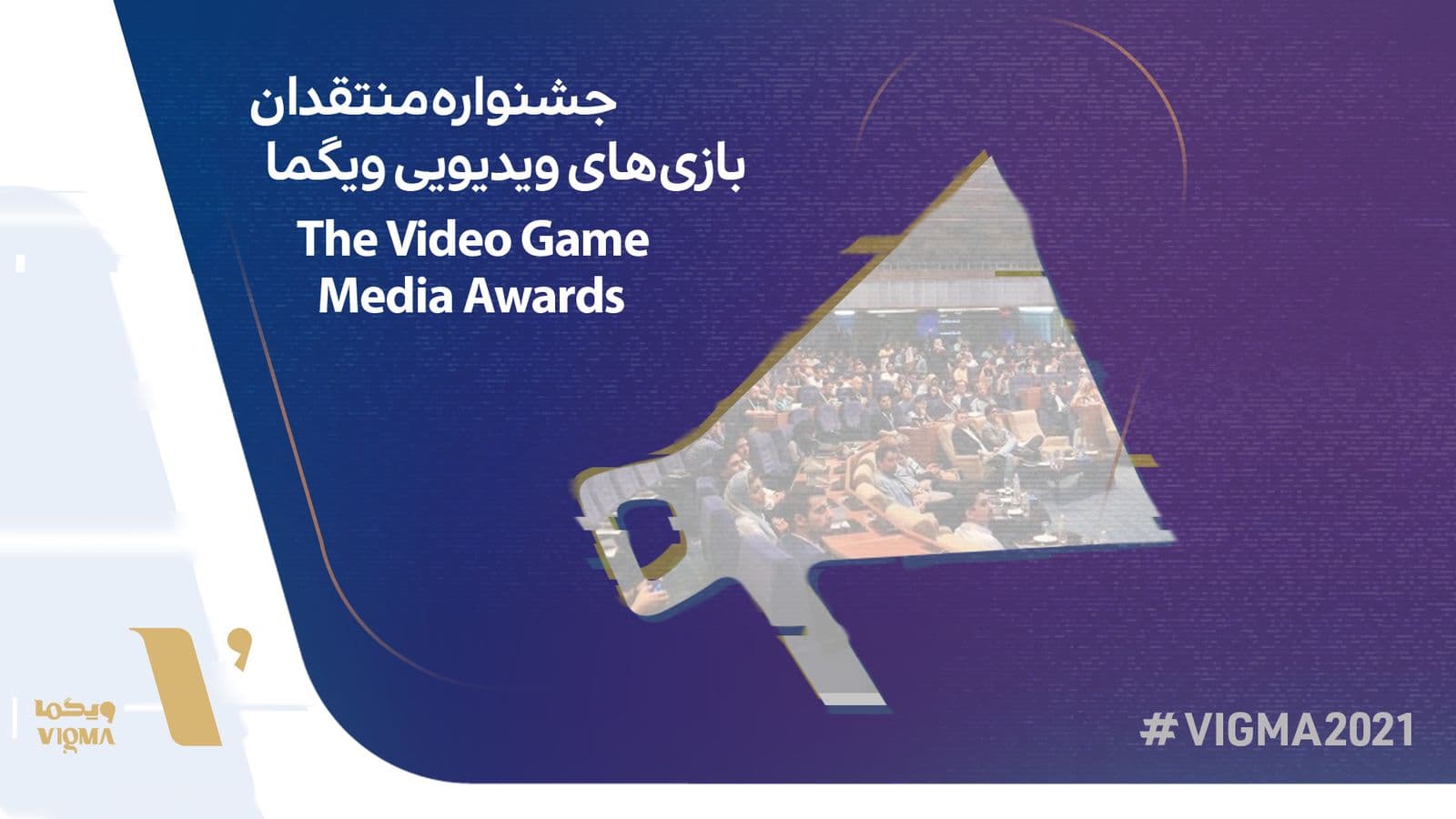
The second Video Game Critics Festival, VIGMA 2021, was held on Friday 15 Mordad 1400 (6 August 2021), and the best Iranian games of the year in the critics' view were announced. Eight speakers also shared their experience at the event.
The VIGMA event was held with the support of Cafe Bazaar as VIGMA's special sponsor and main partner, Tapsell, NikPardakht and the Iran Computer and Video Games Foundation. The conference ran from 10 am to 4 pm, and the VIGMA 2021 closing ceremony began after it. Before the speakers took the stage, Taha Rasuli, head of the conference section, gave an introduction and talked about his experience of this year's VIGMA. Rasuli said all the speakers readily agreed to work with VIGMA to give talks and pass on their experience, and were keen to do so. He explained that game development in Iran is not in good shape: weaknesses in staffing, training and finance have made the work of game teams and studios very hard.
Asked how useful the talks could be for people interested in video games and for game developers, Rasuli explained that he and the speakers had agreed to use the short time available to give the audience a set of leads, rather than spend it on heavy, lengthy subjects. Rasuli said that if he had given a talk this year, it would have been about communication and conversation skills within a team, because the main problem during the coronavirus pandemic is the soft communication between team members.
Arash Naderi, UI/UX designer at CD Projekt RED
Arash Naderi, whose talk was about the nature of prototypes and their importance to a project's success or failure, opened with an example: Halo Wars, first unveiled in 2007, with which the developers set out to prove that strategy games can also play well on consoles. In the prototype and pre-production stage, however, they concluded that despite all their efforts the game was not fun. So they started the project again from scratch and asked Microsoft for about two more years.
Naderi asked how prototypes can decide whether a project fails or succeeds. To answer, he turned to Alfred Hitchcock's method: "Start with the widest shot and finish with the smallest detail."
Naderi then showed images of the prototypes of three famous, large games: Assassin's Creed IV: Black Flag, Resident Evil 7 and The Legend of Zelda: Breath of the Wild. Their developers built early versions of the games with Unity before making them.
For Resident Evil 7, Naderi pointed out that the developers' most important question was what the game would be like with a first-person camera. Another important question was whether realistic graphics were achievable, and by what methods. The developers finished the prototype within a year and got answers to all their questions.
The next game Naderi examined was Breath of the Wild, whose prototype was designed entirely in 2D. The developers' biggest question was how the game's key elements, earth, wind, water and fire, would interact dynamically with each other in the gameplay and the game world.
Next came Assassin's Creed: Black Flag. The developers' big question for this game was naval combat and everything around it, so much so that they decided to build the prototype entirely around sailing and ship battles to answer their gameplay questions.
In closing, Naderi summed up that, in general, we need to understand the importance of prototypes to find answers and solutions in four areas: the three Cs (characters, controls and camera), the core of the game, UX (user experience) and production value.
Ehsan Kangarani, head of games at Cafe Bazaar
According to Ehsan Kangarani, head of games at Cafe Bazaar, gameplay design and game economy design are not separate: developers should consider the two together and develop them in parallel to have a successful mobile game.
Kangarani explained that, unlike a few years ago, games now find it harder to become popular with users and succeed in the market. Users' greater access to foreign stores, a crowded domestic market and the limited capacity of store promotion all play a part.
Kangarani went on to say that every store's promotion, Cafe Bazaar's included, is a valuable asset, and a store prefers to spend that asset where it brings long-term value. He also used several charts and examples to show the importance of promotion on Cafe Bazaar.
Kangarani divided mobile game marketing into two parts: App Store Optimization and User Acquisition. App Store Optimization deals with how the game's store page looks and how effective it is (the icon, images and description), while User Acquisition comes through search, social media advertising, TV advertising and other channels.
Kangarani then raised an important question game developers ask: "Should we do our own marketing or work with a publisher?" He said there is no set answer. Some teams focus on the technical side of their game and do not use a publisher; others, looking at their own abilities and circumstances, hand marketing to a publisher. Working with a "good" publisher is, of course, very important.
In the last part of his talk, Kangarani said that for the Iranian game industry to grow, we need marketing and promotion to reinforce each other, and we need "success stories". He said that raising awareness of a game or a project is extremely important and can make the path of marketing much easier and faster.
Mohammad Amini, senior game designer at Fingersoft
Mohammad Amini, senior game designer at Fingersoft, began by introducing himself and his background. Amini previously worked as a game designer and product manager at Madrik studio, on games such as Khoroos Jangi, Behesht-e Ashpazi and Babashah.
Amini explained that his view of the Business Development Manager role is not complete, so he advised the audience to think about and research what he presented. He pointed out that companies define each role in their own way, and what he described does not hold for every studio.
According to Amini, the main areas of a Business Development Manager's work are dealing with stores, constantly studying markets and products and building a knowledge base, finding new revenue opportunities, and enabling the development teams in related areas.
Amini then described the role with an interesting example. He said that in a game studio or team, this person's role is to connect with the world outside the studio and build bridges to opportunities and paths to success.
Constantly monitoring markets and following products and features in development, constantly comparing KPIs and performance with successful products and competitors, playing a serious part in defining new projects, and building the knowledge base of market research are among the important things a BDM can add to a game team.
On dealing with stores, Amini said this area can be seen as a mix of B2B relations and the knowledge base. Working with stores to benefit from their features and promotions, and from the knowledge and data of different stores, is another way a BDM contributes to a team.
On enabling development teams, Amini said the business development manager is, in a sense, the development team's window on the outside world, and selecting, discovering and introducing products and services that meet the team's needs is part of the job.
Behnam Keshani, head of digital marketing at NikPardakht
Opening his talk on the place of cryptocurrencies in the video game industry, Behnam Keshani divided crypto's entry into games into blockchain-based games, games with in-app purchases in cryptocurrency, games' own tokens, and crypto-based gaming platforms.
After showing the trailer of CryptoKitties, one of the most popular crypto and blockchain games, Keshani, head of digital marketing at NikPardakht, went through the top gaming crypto tokens, with Axie Infinity at the top of the table.
Keshani went on to talk about notable crypto and blockchain projects or tokens in the video game industry and explained the role of each. These projects included Enjin, Decentraland, LOOM, THETA and DREAM.
Keshani talked about the ways gamers can earn money from crypto and blockchain games. Trading tokens on exchanges, selling items within the game itself and selling game items as NFTs were the main points in this part.
On selling game items as NFTs, Keshani noted that more and more blockchain games are moving towards selling in-game items as NFTs, and these items are sold at striking prices.
On revenue for companies, Keshani pointed to several things useful for game developers: trading tokens on exchanges, in-app payment in crypto, issuing tokens and transaction fees.
Keshani explained that cryptocurrencies have only just entered the game industry and much of their potential is still undiscovered. Among the things he expects in the future of crypto games are compatibility between games, crypto casinos and the use of graphics processor technology. According to Keshani, GPUs are used today only to mine cryptocurrency, but in future their use in the crypto world will reach higher levels and new capabilities and potential will become available.
Yasaman Farazan, programmer and game designer at Massive Miniteam
Yasaman Farazan began by defining an independent game team. According to her, an indie team is one with few members that makes games on a limited budget; having no investor or publisher means the team makes its own decisions about its game, and it usually makes more creative titles than AAA games do. Farazan explained that almost all the games on the Iranian market today count as indie titles. She also mentioned some of the most successful indie games in Iran.
An important point she raised was survivorship bias. Farazan said that when we look at these successful indie projects, we fall into survivorship bias: we see only the successes and ignore the failures (failed projects), which are far more numerous.
The first challenge Farazan sees for an indie team is choosing the right game. In her view, the game should be chosen with the team's resources in mind (the abilities and experience of its core members, its budget, its time and so on), the size of the game and project, the team's goal in making it, the target market and current trends.
Another big challenge for indie developers is money. To meet it, developers can raise funds from a publisher or investor, use crowdfunding, use their own money, apply for government grants or loans, or take on contract work.
On staffing and relations within the team, Farazan's solutions included recruiting and growing the team, reducing psychological pressure, getting to know teammates better, a sense of psychological safety and trust, and being transparent with teammates.
Farazan explained that besides its internal relations, an indie studio needs external relations, and this is one of the challenges indie teams face. Her solutions are public relations (PR), business relations (BR) and connections with other teams and the developer community.
Planning and management are also serious challenges for an indie team. Farazan's solutions here are understanding the producer's role in the team, using planning and task-tracking tools, holding regular meetings, and staying flexible while keeping to a plan.
Elham Ahmadi, head of the campaign team at Tapsell
Elham Ahmadi, head of the campaign team at Tapsell, began by describing the types of in-app advertising. The content used as advertising in games and apps includes native banners, interstitial banners, video, playable ads and text.
For a native banner, Tapsell asks for a logo, a slogan, a call-to-action button and three banners in different sizes. Several games were used as examples to explain these options. In Quiz of Kings, for instance, the prompt confirming that you want to leave the game shows an ad with a slogan, a logo, a title and a banner.
Ahmadi divided the key factors of success in in-app advertising into four: the rate at which the ad is watched in full, the click-through rate, the install rate of the advertised game or app, and eCPM. The last, eCPM, is revenue relative to impressions, an important figure for publishers.
According to Ahmadi, more variety in banners and ad campaigns brings more users and, above all, more engagement from them. In her examples, changing just one colour or the wording of a single word led to a striking rise in user engagement.
On searches in Google or the stores, Ahmadi described three options: branded search ads, search ads with a keyword list, and Tapsell Bidar. Tapsell Bidar is a bot that shows your ads in various categories beyond the keywords you entered in your list.
For example, a search for the word "football" brings up the game Clubi as an ad and the first result, and a search for "Munchers" shows the game Munchico as an ad and the store's first result. This happens because these games won the auction for those names.
Row ads work so that when a user searches for a name, a set of ads appears in a horizontal row before the main results. Their order in the row depends on what the developers or publisher pay.
Ahmadi said that knowing the goal of an ad campaign is important for game developers. Branding, acquiring active users and revenue are all goals that game teams choose according to their circumstances and pursue through ad campaigns.
Mohammad Iraji, senior programmer at Ubisoft
Mohammad Iraji opened by saying that there are broadly two kinds of management in teams and startups: centralised, top-down management, and management in which the upper layers are separate from the lower ones. In his view, centralised management may work in small teams but does not work in large ones.
According to Iraji, management serves the team (not the employees the manager). A team's manager sets goals, clears the way to them without interfering in how team members do their work, and can say precisely why a goal was missed or met.
Using examples, Iraji said the first reason any game team succeeds is a shared goal. A shared goal and outlook among team members delivers the result you want at the end of development. In short, he said, the aim of OKRs is alignment, discipline and prioritisation, and stronger conversation within the organisation.
According to Iraji, an OKR (objectives and key results) has a clear goal, and reaching it requires a few concepts. The first point about a goal is that it should be S.M.A.R.T.: S stands for specific, M for measurable, A for attainable, R for relevant and T for time-based.
Iraji considers several factors in setting a team's goal. In his words, the goal should be ambitious, the team should reach at least 60 percent of it, it should leave room for growth and take the team out of its comfort zone, it should be visible to everyone in the company, and it should be neither repetitive nor simple.
For example, if an organisation's goal is higher customer satisfaction, the product team's goals are to identify 10 features users need, hire 2 UX designers to improve the user experience, and fully implement a customer contact panel. The other teams' goals (sales and engineering) follow the organisation's goal in the same way.
Iraji said success is not a goal but a way of working. He explained that a team's big overall goal is broken down among all its members. Each person then decides how to do a piece of work to reach the goal, and how to reach their own goal and, in the end, the organisation's.
At the end of his talk, Iraji, senior programmer at Ubisoft, spoke about what OKR management can achieve: "preventing micromanagement", "synergy" and "focusing on outcomes rather than output" are among the gains OKRs make possible.
Mohammad Zehtabi, head of Paeezan studio
Mohammad Zehtabi, head of the game studio Paeezan, began by listing the stages of working with a publisher: finding a publisher, testing the game, the contract, monthly settlement, and ending the contract.
Zehtabi said that assessing a publisher you plan to negotiate and work with is extremely important, and that several things matter in that assessment: the games it has released, its history, its number of employees and its country.
Working with the publisher is another important part of the relationship. According to Zehtabi, at this stage the developer tests and evaluates the game. Because this testing can be very long and exhausting, he suggests working with several publishers at the same time.
Zehtabi then turned to the contract, perhaps the most important subject in dealing with a publisher. The length of the contract, its language and country, the obligations of both sides, running costs, the advance, how revenue is shared and the terms for ending the contract are the most important points here.
According to Zehtabi, several of a publisher's obligations are especially important: user acquisition (effort is not enough; commitment is needed), producing advertising content (creatives), localisation, data analysis, support, and managing social media.
Zehtabi then talked about a game's running costs. These include the cost of developing the game (the developer), making creatives (negotiable), user acquisition (recoupable), the service (usually the developer), services, and localisation (the publisher).
On revenue sharing, he explained that the publisher and the developer each ask for between 70 and 30 percent of revenue, depending on the size and track record of the publisher or developer. Tiered models can also be used to share revenue.
In the last part of his talk at VIGMA 2021, Zehtabi said a contract between a publisher and a developer should not become a prison, and developers should not stop connecting their game and project to other publishers just because they have signed with one.
VIGMA 2021 nominees and winners
After the conference came the VIGMA 2021 closing ceremony, where the jury's votes chose the best Iranian games of the year.
Most Creative Game of the Year
The nominees for Most Creative Game of the Year were Fix It, Achird World, Silence Channel, 1:011 and Loran: Adventure in a Dream, and the award went to Fix It by Infinite Darkness.
Best Game Design
The nominees for Best Game Design were Ghand o Pand, Golpari, Sharifabad, Bezan Bahador and Golshifteh, and the award went to Golshifteh by Madrik.
Best Story and Narrative
The nominees for Best Story and Narrative were Silence Channel, Beyond Here 2, The Dark Room, 1:011 and Golshifteh, and the award went to The Dark Room by Lexip Games.
Best Art Direction
The nominees for Best Art Direction were Sharifabad, Silence Channel, Bezan Bahador, Golpari, 1:011, The Dark Room and Golshifteh, and the award went to Golshifteh by Madrik.
Best Ongoing Game
The nominees for Best Ongoing Game were Persity, Quiz of Kings, Tizball, Munchers and Pesarkhandeh, and the award went to Pesarkhandeh by Paeezan.
Best Music and Sound
The nominees for Best Music and Sound were Ghand o Pand, Bezan Bahador, Sharifabad, The Dark Room and Golshifteh, and the award went to Golshifteh by Madrik.
Most Anticipated Game of the Year
Moon Lake by Averted Vision was named Most Anticipated Game of the Year and received the award. As announced earlier, the winner of this award can attract up to 1 billion toman of investment from 100 Startups.
Game of the Year
Ghand o Pand, Sharifabad, Silence Channel, Golpari, The Dark Room, Bezan Bahador, Golshifteh, Taskhirgaran, Fix It and 1:011 competed for Game of the Year, and in the end the jury of the second VIGMA named The Dark Room by Lexip Games the Game of the Year.